Montclair Town Square: What Buyers Need to Know Before They Look Further
Nshama, Town Square, and Why the Location Has a Track Record
Nshama developed Town Square as a self-contained community in the southern stretch of Dubai, sitting along Al Qudra Road. It is not a central location. Buyers who need to be in DIFC or Downtown every morning should factor in a 30 to 45 minute drive at peak hours. That is the honest trade-off.
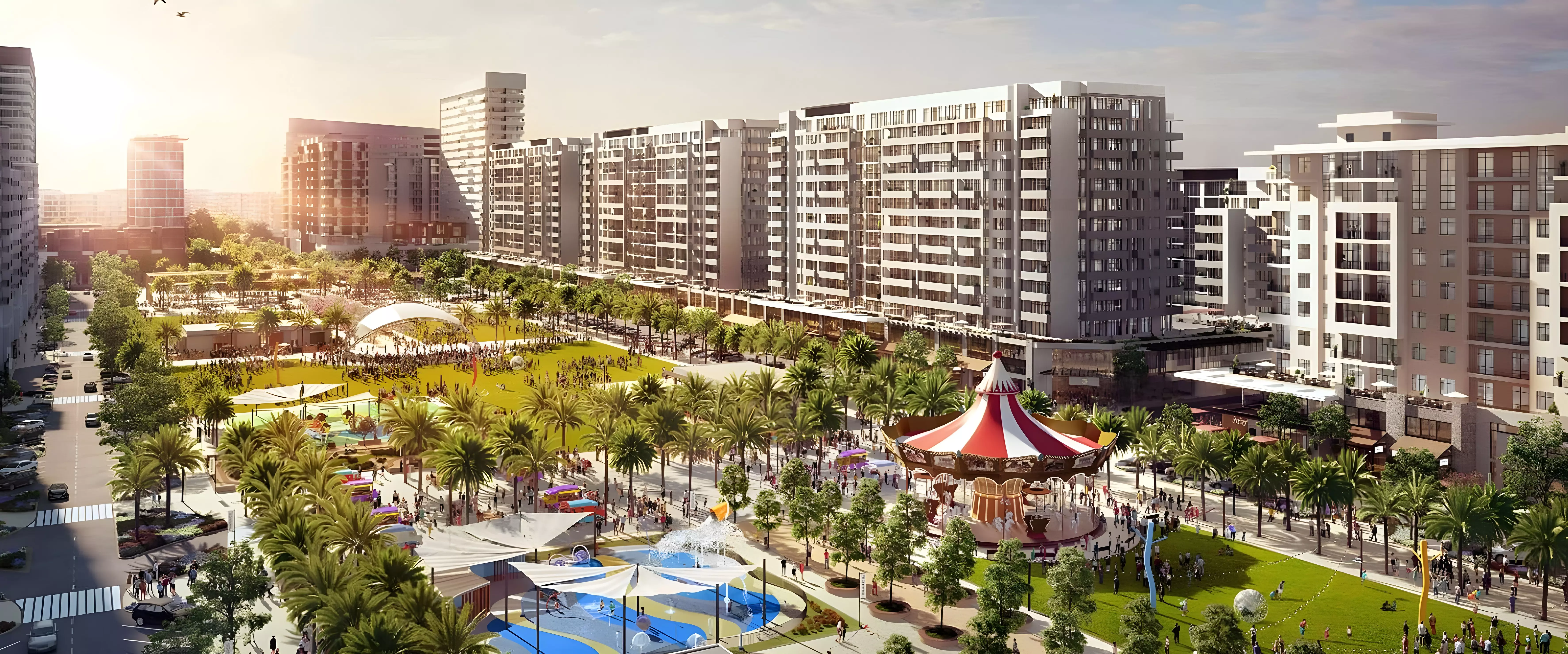
What Town Square offers in return is community infrastructure that actually exists. Parks, retail, dining, and schools are already built and operating across the wider masterplan. Nshama has delivered multiple projects here before Montclair, so buyers are not betting on a blank plot and a promise. The neighbourhood has residents, footfall, and a functional daily environment. For families prioritising space and greenery over a central address, this location makes sense. For investors, the rental thesis rests on affordability relative to more central districts, which tends to keep occupancy steady.
One Price Point, One Product
The pricing here is straightforward. Montclair Town Square lists at AED 900,000, with no spread between minimum and maximum. That tells you something useful: this is a project with a defined product rather than a range of configurations. You are likely looking at a specific apartment type, probably a one-bedroom or a compact two-bedroom, rather than a menu of sizes and layouts.
At AED 900,000 in Town Square, this sits in line with current market rates for the community. It is not a bargain entry, but it is not priced above what the location supports either. The buyer profile is specific: a first-time owner-occupier looking for an affordable Dubai foothold, or an investor targeting the mid-market rental tenant who cannot stretch to closer-in communities but wants a proper neighbourhood rather than an isolated building.
What You Are Buying
The project offers apartments only. No villas, no townhouses. If you need outdoor private space or a garden, this is not it. For buyers who want a low-maintenance urban apartment within a community setting, the format works well.
The Amenity Set
| Category | Facilities |
|---|---|
| Fitness and Wellness | Gymnasium, Indoor Swimming Pool |
| Outdoor and Family | Landscaped Gardens, Children's Play Area |
| Convenience and Safety | Restaurants, CCTV Security |
An indoor pool is worth flagging briefly. Most apartment projects in this price bracket offer outdoor pools, which sit unused for several months during Dubai's summer. An indoor pool means year-round usability, which is a practical upgrade for residents.
The overall amenity set is modest and functional. Six facilities points to a project designed for everyday living rather than resort-style excess. That is not a criticism. It reflects the price point honestly. The target resident is someone who wants a gym, a safe play area for children, and greenery outside their window without paying for a hotel lobby they will never use.
Construction Has Just Started
Construction started in April 2026, with an expected handover in May 2028. That gives a build period of roughly two years. For an off-plan buyer entering now, you are looking at a 24-month wait before you get keys. The project data was updated in early April 2026, confirming this is a live, just-launched development.
The timeline is standard for Dubai off-plan. Two years is not unusually long, but buyers should plan for that horizon honestly, particularly if they are counting on rental income.
Getting In for 10%
| Stage | Payment |
|---|---|
| Down payment | 10% |
| During construction | 40% |
| On handover | 50% |
The 10% down payment is a low entry point by Dubai standards. Many comparable projects ask for 20% upfront. Here, you can secure a unit for AED 90,000 at signing, which keeps the initial capital commitment manageable.
The structure to watch is that 50% falls at handover. There is no post-handover payment plan. For buyers relying on a mortgage, this is standard and works cleanly. For cash buyers, the back-loaded structure means the majority of your capital goes in at the end of the construction period, not spread across it. That can work in your favour if you are managing liquidity across two years, but you need to be ready for a significant payment at the handover date.