
How to find what a Dubai unit really sold for, and why portal averages mislead
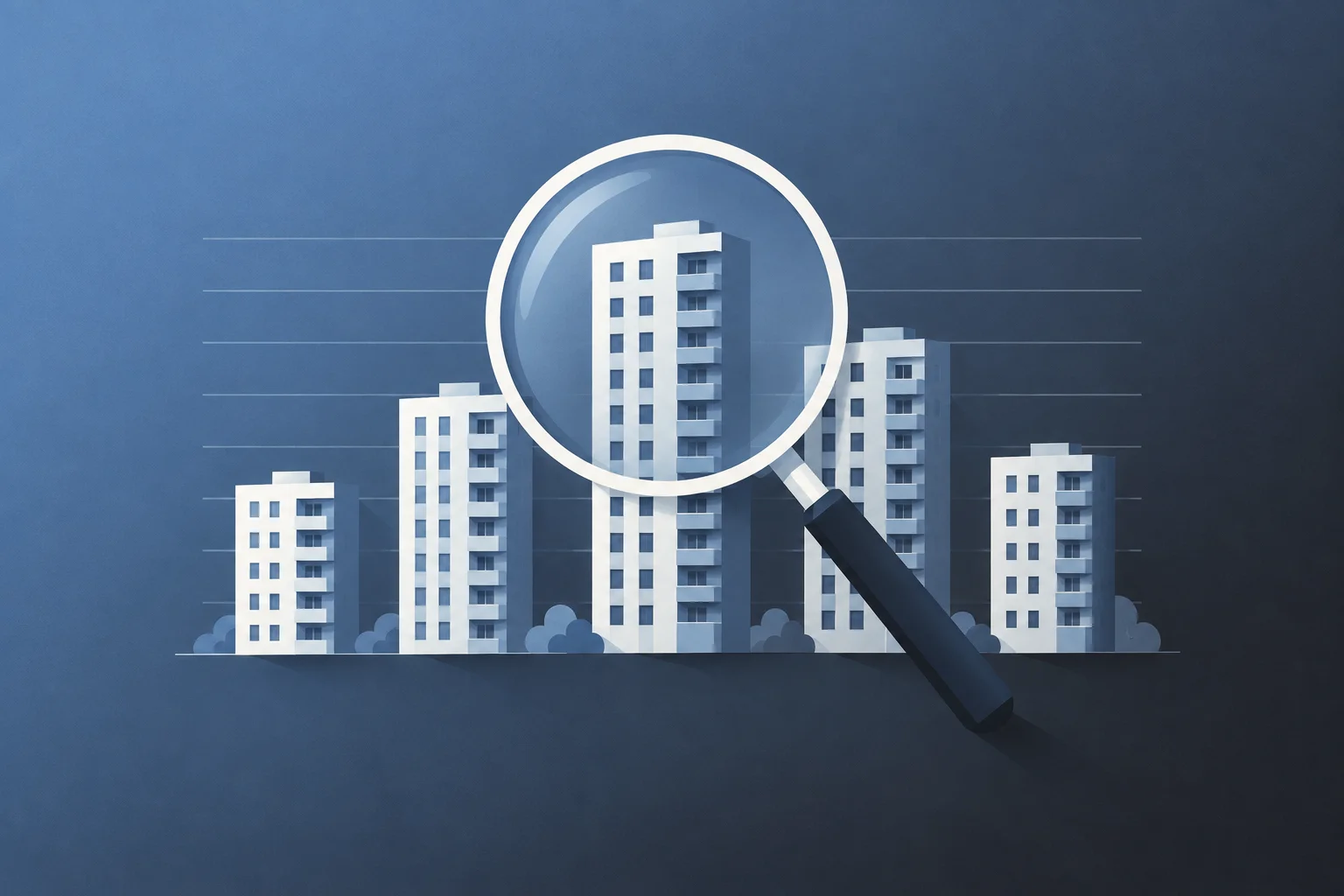
Portal averages are cleaned and blended. DLD transaction data shows registered sales but omits floor, view and condition, so comparables need adjusting.
On this page
- Why a portal average isn't a comparable
- The official sources: what each one actually shows
- What a transaction record includes, and what it leaves out
- Off-plan, ready, and mortgages: reading the mix correctly
- A worked comparable-sales method, normalised by price per square foot
- Portal averages versus registered transactions: the actual gap
- Getting an official valuation certificate
Most Dubai property portals show a single "average price" line for a building or a community. That figure tells you almost nothing about what a specific unit, on a specific floor, in a specific condition, actually sold for last month. The Dubai Land Department (DLD) publishes the underlying transaction records that those averages are built from, and several tools let you read that data directly. Using them well means knowing which tool shows which fields, which transactions are sales versus mortgages or gifts, and how to turn a handful of comparable rows into a defensible price estimate rather than a guess dressed up as a number.
Why a portal average isn't a comparable
Property Finder's own Dubai transactions page states that its figures come from DLD data "following a thorough cleanup to exclude any outliers," and it warns that "the displayed values may differ from those available on the DLD website." That disclosure matters more than the chart next to it. A sitewide or building-wide average blends off-plan and ready units, every bedroom count, and every size band into one line. It is portal data, cleaned by a method the portal doesn't fully publish, not a registered transaction you can point to. When a guide says a portal's average sale price and rental yield cover "all registered transactions after cleanup," that's broadly accurate as a description of what the portal does, but it's a different object from a comparable sale, and treating it as one is where most DIY valuations go wrong.
The same portal lists two separate size fields, plot size and built-up area, for the same unit. A price-per-square-foot figure only means something if both sides of a comparison use the same one of those two bases. Mixing them quietly inflates or deflates the number without anyone noticing.
The official sources: what each one actually shows
Three tools are worth knowing, and they are not interchangeable.
DLD's own open data page groups its published datasets into Transactions, Rents, Projects, Valuations, Land, Buildings, Units, Brokers and Developers, with transaction records themselves split into Sales, Mortgages and Gifts rather than one undivided feed. The site that used to be the default pointer for pulling this data, dubaipulse.gov.ae, now returns a 301 redirect to data.dubai, run by the Dubai Data and Statistics Establishment under Digital Dubai. As of this review, data.dubai's own page for the DLD transactions dataset still shows a notice that the page "is under development," so dataset-level field documentation has to be confirmed from the live DLD site or from the API response itself rather than from that landing page. Underneath both front ends, the DLD Transactions Open API is documented as covering sales, mortgage, inheritance, merge, separation and sub-separation transactions, sourced from the Department's Tabu registration system, with the underlying data updated daily.
Dubai REST, the Land Department's own app, does two different things depending on who is asking. A verified owner can sign in with UAE Pass to view the registered transaction history tied to a title deed they actually hold. Separately, the app offers area-level "Market Insights" analytics without that login, aimed at anyone researching a neighbourhood rather than checking their own deed.
DXBinteract sits outside government entirely. Its Google Play listing names the developer as fam Properties, a Dubai brokerage, and the app is built on licensed DLD data rather than operated by DLD or RERA. Its project pages, for example a Dubai Marina building, show individual sale rows without requiring login: status (ready or off-plan), transaction date, recorded price, price per square foot, bedroom count and size. That's a genuinely useful, listing-derived view into real registered prices. It comes with a catch worth flagging rather than resolving: the same pages that show those rows also carry a notice that "property numbers displayed within this platform are visible only to users with a valid RERA registration," which sits uneasily against rows a logged-out visitor can already see. Which access level actually governs a given page is not something this review could pin down, so treat free public access to DXBinteract as partial and possibly variable, not a confirmed full dataset.
| Source | Who runs it | Login needed | What you actually see |
|---|---|---|---|
| DLD open data / data.dubai | Dubai Land Department / DDSE | No | Raw sales, mortgage and gift datasets and the Transactions Open API |
| Dubai REST | Dubai Land Department | Yes, for your own deed | Your title's history (with UAE Pass); area Market Insights without login |
| DXBinteract | fam Properties (private brokerage) | Partial, inconsistently enforced | Per-project sale rows: price, price/sqft, date, size |
| Portal transaction pages (Property Finder, Bayut) | Private portals | No | Cleaned, aggregated listings of DLD-sourced sales, with stated caveats |
What a transaction record includes, and what it leaves out
DLD's transaction fields, as documented on the open data page, include registration type (ready or off-plan), usage category, property type, room count, parking availability, nearest metro, nearest mall and nearest landmark, plus the transaction amount and the size. No field in the dataset records a unit's condition, its floor level, its view or orientation, or its furnishing status. This is the gap that trips up anyone trying to use raw transaction data as a finished comparable: two units in the same tower, same size, same bedroom count, can register wildly different prices because one faces the marina and the other faces a car park, and the dataset gives you no way to tell which is which from the row alone.
A third-party compilation of this dataset, published on Kaggle and built from DLD open data, illustrates the scale involved: 1,512,843 rows across 46 columns spanning 2004 to mid-2025, including bilingual nearest-landmark, nearest-metro and nearest-mall fields. That size is useful context for how much history exists to search through, though a compilation like this is a specialist re-packaging of the official feed, not the feed itself, and carries whatever lag existed at the point it was compiled.
Off-plan, ready, and mortgages: reading the mix correctly
Because mortgage registrations and gift transfers sit in the same transaction system as sales but are tagged as separate groups, a raw count of "transactions" in a given period at DLD is not the same figure as a count of sales. If you pull data without filtering by group, you risk double-counting or mis-weighting your comparable set, especially around periods when refinancing activity spikes.
Off-plan sales carry their own registration logic. Law No. (13) of 2008, which regulates Dubai's Interim Real Property Register, requires that any sale or other disposition of an off-plan unit be entered in the Interim Property Register; a disposition that isn't registered is void. Some current guides describe this as an ongoing 60- or 90-day deadline that a developer must meet on every new off-plan sale. That's a myth worth correcting: the 60-day window actually named in the law, Article 3(2), was a one-time transitional rule requiring registration of dispositions made before the law took effect in 2008. It is not a standing clock that resets with each new contract. What does carry forward is the underlying registration requirement itself and the Oqood interim entry that evidences it. When an off-plan project reaches completion and handover, DLD converts that Oqood registration into a full title deed; before that point, the Oqood entry is the buyer's only registered evidence of the purchase, and it's the record that would show up in a transaction search for that unit while the building is still under construction.
A worked comparable-sales method, normalised by price per square foot
Accredited valuers in Dubai are generally expected to work from a comparable-sales approach aligned with International Valuation Standards and the RICS Red Book, pulling registered transactions and adjusting for size, floor, view, condition, age and finish. Some valuation firms publish a specific rule of thumb, such as wanting five comparable sales within the past six months, but no single published regulatory document sets that exact threshold as a universal minimum. Treat a firm's stated comparable count and time window as its own working practice, not a RERA rule, while the underlying method, comparing registered sales on a normalised basis, is well established.
Here is the same logic applied by hand, using invented figures for illustration rather than real DLD records, since no specific comparable set for a named building was available in this review.
Say you've pulled three recent registered sales for similar one-bedroom units in the same tower from a transaction source:
| Unit | Recorded price | Size (sqft) | Price per sqft |
|---|---|---|---|
| Comp A | AED 1,850,000 | 1,050 | AED 1,762 |
| Comp B | AED 2,100,000 | 1,180 | AED 1,780 |
| Comp C | AED 1,760,000 | 1,000 | AED 1,760 |
Each price-per-square-foot figure is a derived calculation (price divided by size), not a field the dataset reports directly, so it has to be computed and checked, not quoted as published. Averaging the three gives roughly AED 1,767 per square foot. Applying that to a subject unit of 1,100 square feet gives an indicative value near AED 1,943,700, before any adjustment for floor, view, condition or finish, none of which the raw transaction rows would tell you. That adjustment step is where a valuer's judgement, or at minimum your own honest comparison of the units in person or in photos, has to do the work the dataset can't.
Two checks matter before trusting a comparable set like this. First, confirm every row is tagged as a sale, not a mortgage or gift registration riding in the same dataset. Second, confirm every size figure uses the same basis, built-up area versus plot size, since mixing the two produces a price-per-square-foot number that looks precise and is actually comparing different things.
Portal averages versus registered transactions: the actual gap
Once you've built a comparable set this way, it's worth checking it against whatever average a portal publishes for the same building, mainly to understand why the two numbers rarely match rather than to treat the portal figure as a second opinion. Property Finder's own disclaimer, again, says its figures are DLD-sourced but cleaned of outliers and may diverge from the DLD website's own numbers. A building-level or area-level average also blends unit types, sizes and completion status that your comparable set deliberately narrows down, so a gap between your figure and a portal's isn't evidence either one is wrong. It usually just means they're answering different questions.
Some scale claims circulating about these portals couldn't be confirmed against any official source and are worth treating with caution rather than repeating. One portal built on a licensed government feed says its figures update daily and cover a very large number of registered sales; that coverage claim is self-reported and wasn't independently verifiable here. Separately, a specific error margin for Dubai REST's Market Insights valuation estimates circulates in third-party guides, but no DLD, RERA or Central Bank publication stating that figure could be located, so it should be treated as unconfirmed rather than cited as fact.
Getting an official valuation certificate
If a comparable-sales estimate isn't enough, for example for a mortgage, a dispute or a formal sale, DLD's own Taqeemi valuation service is the route that produces a certificate rather than an estimate. The published fee schedule prices a residential apartment or villa valuation at AED 4,000, vacant commercial or industrial land at AED 2,000, agricultural land and buildings at AED 6,000, major-project land at AED 10,000 and a hotel building at AED 15,000, each plus a AED 10 knowledge fee and a AED 10 innovation fee. Processing time is routinely misreported: DLD states the certificate is issued instantly for a residential unit or an attached villa, and takes up to 7 working days for every other category, not the shorter window some guides quote. It can be requested at a Real Estate Services Trustee Centre, through the Dubai REST app, or through the Dubai Now app.
If the transaction involves a mortgage rather than a cash purchase, registering it with DLD costs 0.25 percent of the loan amount plus a flat AED 290 administrative fee. Multiple mortgage-advisory sources report that, since February 2025, this fee must be paid upfront rather than financed into the loan, though this rests on consistent secondary reporting rather than a DLD fee circular that could be located directly during this review, so treat the upfront-payment detail as reported rather than confirmed from the primary source.
Frequently asked questions
Is DLD's transaction data the same as what portals show me?
No. Portals like Property Finder and DXBinteract build their pages from DLD-sourced data but apply their own cleanup, filtering or access rules on top of it. The underlying sale may be the same record, but the number you see has been through a process the portal only partly discloses.
Can I see what my own unit sold for on DLD's own system?
Through Dubai REST, yes, if you hold the title deed and sign in with UAE Pass. The app's area-level Market Insights tool, by contrast, doesn't require that login because it isn't showing you a specific deed's history.
Why do price-per-square-foot comparisons sometimes look inconsistent across sources?
Usually because the sources use different size bases. Property Finder, for instance, shows plot size and built-up area as two distinct fields for the same unit, and a comparison across listings only holds if both sides use the same one.
Does a developer have 60 or 90 days to register an off-plan sale?
No. That 60-day figure, drawn from Article 3(2) of Law No. (13) of 2008, was a one-time transitional rule for sales made before the law took effect in 2008. The standing requirement is simply that an off-plan disposition must be entered in the Interim Property Register or it is void, with no recurring 60- or 90-day clock attached to each new sale.
How quickly can I get an official DLD valuation certificate?
Instantly for a residential unit or an attached villa; up to 7 working days for other property categories, requested through a Trustee Centre, Dubai REST, or Dubai Now.
Sources
- Dubai Land Department, open data page: https://dubailand.gov.ae/en/open-data/real-estate-data/
- Dubai Land Department, property valuation e-service page: https://dubailand.gov.ae/en/eservices/property-valuation/
- Dubai Pulse / data.dubai, DLD Transactions Open API documentation: https://api.dubaipulse.gov.ae/open/dld/dld_transactions-open-api
- data.dubai, direct fetch observed 2 October 2026: https://data.dubai/
- dubaipulse.gov.ae, direct fetch observed 2 October 2026 (redirects to data.dubai): https://www.dubaipulse.gov.ae/
- Law No. (13) of 2008 Regulating the Interim Real Property Register in Dubai, Article 3: https://dlp.dubai.gov.ae/Legislation%20Reference/2008/Law%20No.%20(13)%20of%202008.html
- Property Finder, Dubai transactions page: https://www.propertyfinder.ae/en/transactions/buy/dubai
- DXBinteract, project page observed 2 October 2026: https://dxbinteract.com/projects/marina-promenade
- DXBinteract, "our story" page: https://dxbinteract.com/our-story
- Google Play, DXBinteract app listing: https://play.google.com/store/apps/details?id=com.famproperties.property_trends
- Kaggle, "Dubai Real Estate Transactions Dataset," compiled from DLD open data: https://www.kaggle.com/datasets/alexefimik/dubai-real-estate-transactions-dataset
Related articles
Dubai mortgage valuations: the bank picks the valuer, and the loan follows the appraisal
Circular 31/2013 caps the loan as a share of appraised value, not price. The bank chooses the valuer, and a DLD certificate will not replace its report.